
SMAIR Bootcamp Highlights: Week 4 – Where Big Ideas Become Working Prototypes 🚀
- smairfoundation
- Aug 23, 2025
- 5 min read

Updated: Aug 24, 2025
Week 4 was where theory transformed into tangible tech. Our students took on complex ideas like automation, the Internet of Things (IoT), and game design, breaking them down into hands-on projects they built from the ground up.
From sensor-activated doors to Disney-inspired games, this week was all about turning knowledge into creation.
Of course. Here is a more detailed and expanded version of the weekly highlights. This version elaborates on the learning processes and the significance of each activity while keeping the original project names and the professional, engaging tone.
Robotics, Sensors & Smart Devices


For our older students, this week marked a significant leap from foundational coding to creating intelligent, integrated systems. They moved beyond simple commands to build projects that could sense, process, and physically respond to their environment, delving into the core principles that drive modern robotics and smart devices.
The week began with a deep dive into sensors and their real-world applications. Students learned how devices perceive the world by building circuits that respond to light and dark environments using LEDs and photoresistors. This hands-on exercise demystified the technology behind automatic streetlights and smartphone screen adjustments, showing them how a simple change in light could trigger a programmed response.
Using the versatile PictoBlox platform, they then explored the digital-physical connection further by programming ultrasonic distance sensors. They saw firsthand how block coding could be used to interpret data from the physical world. In this case, measuring distance with sound waves and use that data to make decisions. This critical lesson in input-process-output is the bedrock of all robotics.
The highlight of their week was undoubtedly the Automatic Door Project. This wasn't just an assembly task; it was a comprehensive engineering challenge.
Design & Mechanics: Students first had to conceptualize and build the physical door mechanism, problem-solving the mechanical aspects of their design.
Coding the Logic: They then wrote the code that would serve as the door's "brain." They had to program the sequence of operations with precision: detect a person at a certain distance, activate a motor to open the door smoothly, hold it open for a set duration, and then safely close it.
Testing & Iteration: The final phase involved rigorous testing and debugging, a crucial part of any engineering cycle. They refined their code and adjusted their mechanisms, learning resilience and the importance of iterative improvement.
To conclude the week, the students began the exciting process of brainstorming their capstone projects. Drawing on all the skills they’ve accumulated in robotics and coding, they started sketching, debating, and refining their own unique ideas. This phase represented their first real step into the world of engineering innovation, moving from guided projects to becoming the architects of their own final builds.
Play, Logic & Discovery


For our younger learners, Week 4 was a masterclass in making complex topics accessible and exhilarating. The curriculum was designed to build foundational understanding through play, ensuring that every student felt empowered and curious. They learned the "big words" of technology, like "algorithms" and "circuits," by engaging in experiences that felt more like games than lessons.
Their journey started with the fundamentals of electronics as they wired up LEDs with button switches. This simple, tactile activity was their first experience creating a complete, user-controlled circuit. They then explored these same concepts in software simulations, allowing them to experiment safely and visualize how electricity flows.
A major focus was on developing computational thinking, starting with the completely screen-free Graph Paper Programming activity. In this exercise, one student acts as the "programmer," writing a sequence of simple directions (e.g., move forward, turn right), while a partner acts as the "robot," executing the commands exactly as written on a grid. This fun, collaborative game brilliantly illustrated the core concept of an algorithm: a precise, step-by-step set of instructions for completing a task.
From there, they seamlessly transitioned their new skills to the screen with the Maze Intro Activity. Using a block-based coding interface, they applied the same principles of sequential logic to navigate a character through a series of puzzles. The immediate visual feedback of the character successfully following their commands solidified their understanding and built their confidence as programmers.
The week culminated in a burst of creativity as students explored the Secret Language of Game Creators. They discovered the basic building blocks of game design like events, loops, and conditional logic and then immediately put them into practice. Tasked with designing their own fun games featuring beloved Disney characters, they became storytellers and problem-solvers, sharpening their logic and sequencing skills while bringing their own imaginative ideas to life.
The Big Picture


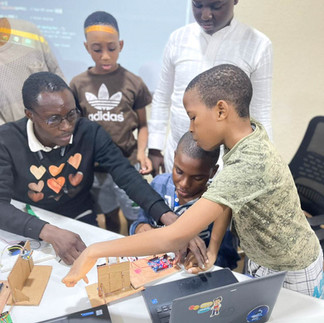


This week powerfully demonstrated that coding and robotics are not just about screens and circuits, they are disciplines that teach a new way of thinking. Whether it was an older student debugging the motor on an automatic door or a younger student rewriting their code to solve a maze, every single one was learning the essential skills of the 21st century: breaking large problems into smaller steps, testing ideas without fear of failure, and methodically building a solution. The real spark ignited this week wasn't in the LEDs they lit up, but in the minds that learned how to create with technology.
What's Next? Get Ready for the Grand Finale: CAPSTONE WEEK!
The countdown begins to the most anticipated week of the entire bootcamp! All the skills our students have mastered are about to be put to the ultimate test. Next week is the final week, and it's all about one thing: bringing their biggest ideas to life.
Mission: The Capstone Project! Students will step into the shoes of real-world engineers and entrepreneurs. Their mission is to identify a challenge they care about and build a functional project to solve it. This is where their creativity is unleashed! From brainstorming and prototyping to coding and testing, they will pour everything they've learned into one incredible final build. We’re not just looking for cool projects; we're looking for innovative solutions.
Showcase Your Genius: The Digital Portfolio! To go with their amazing inventions, students will be building their first professional portfolios. This is their chance to shine! They will document their journey, showcase their best work, and tell the story of how their capstone project went from a simple idea to a working reality. It’s their digital resume, proving what they can do and setting them up for future success.
Prepare to be amazed. The final showcase of projects will be a testament to the incredible talent and hard work of our bootcampers. The future is building, and it starts next week!
Ready to ignite your child's passion for technology and innovation?
We also host engaging weekly sessions every Saturday in collaboration with the AI & Robotics Innovation Hub.
Location: 1B Ibitayo Street, off Adekunle Banjo Avenue, Magodo Phase II, Lagos
Time: 10am - 1pm
Call/Whatsapp: 09161771271
Email: info@smairfoundation.com
Let's give your child more than just screen time. Let's give them the skills, confidence, and spark to build what's next.


Comments